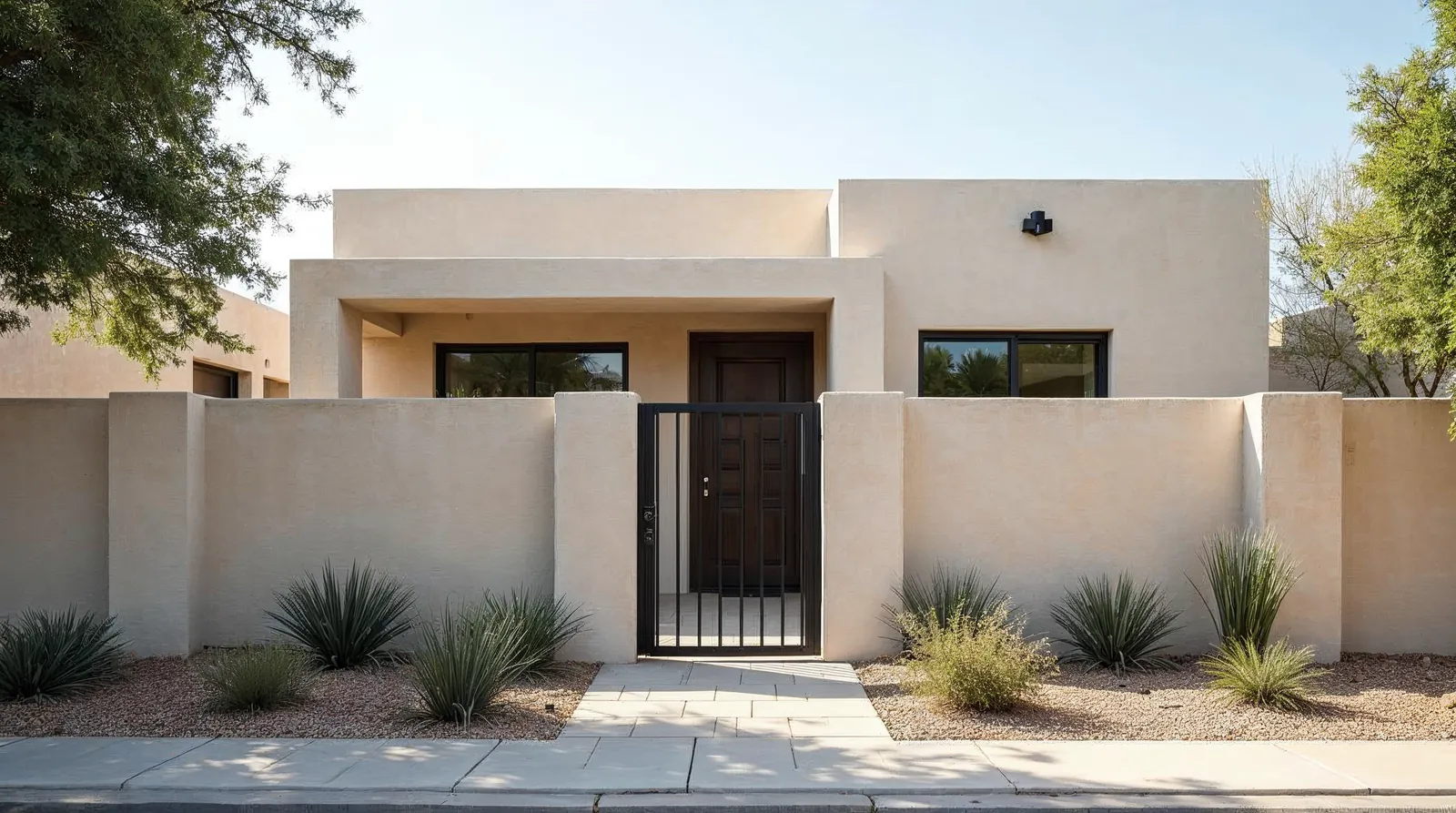
A boundary does far more than mark where a plot begins and ends. It shapes how the street sees the house, how the family uses the garden, how visitors arrive and how a security team or resident reads movement around the property. In Qatar and the wider Gulf, the wall or fence is also a climatic element. It must hold up against glare, dust, wind and intense heat while still looking composed from both sides.
The first question is rarely wall or fence. A more useful question is what the boundary needs to achieve at that particular location. A solid wall can give complete visual privacy but reduce natural surveillance. An open fence can support sightlines and landscape continuity but screen very little. On many plots, the most effective answer is a deliberate combination of both, with the frontage behaving differently from the rear and side edges.
Reading the Boundary as a Working Element
A well-planned perimeter performs several jobs at once. It establishes ownership, deters casual intrusion, controls pedestrian and vehicle movement, protects service areas and frames the architecture. Those jobs can pull in opposite directions. A tall masonry wall around the whole plot may feel private, but it can also create blind corners and make the street feel closed off. A low ornamental fence may look welcoming but do little to stop a determined climber.
For that reason, the strongest boundary is not automatically the tallest or most expensive one. It is the one that responds to the actual conditions of the site. A main entrance may deserve a carefully detailed gate and pillars, while a back-of-house utility edge needs only practical separation. Thinking in zones helps. The front boundary can be lower and more open, while the sides and rear can become taller and more defensive without harming the public face of the house.
Where a Solid Wall Earns Its Place
Privacy Before Visibility
A masonry or concrete wall works best when privacy is the priority. In dense villa compounds or on plots overlooked by neighbouring windows, a solid boundary creates a calm internal world. It also blocks low-level street noise and keeps blowing sand from gathering directly against the house. The trade-off is visibility. A high solid wall prevents anyone outside from seeing a person moving along the inside face, which can be a security weakness rather than a strength.
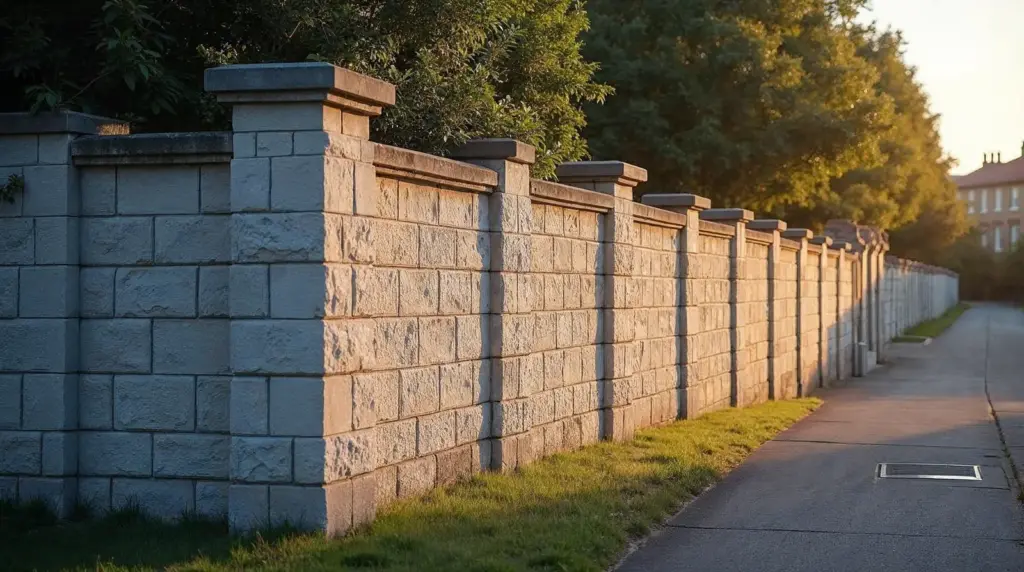
The material matters as much as the height. In the Gulf, reinforced concrete strip footings with movement joints help prevent thermal cracking as ground temperatures shift. Natural stone cladding, fluted coping and low-glare wall lighting can lift a plain block wall into something architectural. Even a rendered wall benefits from a clear top edge and a shadow gap at the base, details that stop it looking like an afterthought.
Height Rules and Community Codes
Height rules vary by community and municipality, so it is wise to check the local development code before finalising drawings. Some master communities set maximum front boundary heights and require design approval for gates and pillars. A wall that ignores those limits can become a costly correction later. The safest approach is to treat the boundary as part of the planning submission, not as a separate landscape item.
Fences, Screens and the Value of Being Seen
An open-view fence or railing supports surveillance. It allows a resident or camera to see through the boundary line, which removes hiding places and makes an opportunistic intruder more visible from the street. This is especially useful at the front of a home, where a lower boundary of around one metre can keep sightlines clear while still marking the edge of the plot. Hedges and shrubs should be kept low for the same reason.
At the sides and rear, taller boundaries are generally recommended. A minimum height of about 1.8 metres makes casual climbing harder, and adding a trellis top of around 0.3 metres increases the difficulty without creating a fortress feel. Prickly planting against fences and below accessible windows adds another quiet layer of resistance. The goal is not to build a prison but to make the boundary read as deliberate and maintained.
Laser-cut metal screens and mashrabiya panels offer a Gulf-specific middle ground. They filter views, admit air and light, and create a patterned shadow on the ground. A screen can give privacy at eye level while still allowing a security camera to read shapes and movement through the gaps. The best results come when the pattern is scaled to the distance from the street, so it reads as a texture rather than a visual barrier.
Gates That Move Well and Age Quietly
Planning the Daily Mechanics
The gate is the only part of the boundary that has to perform mechanically every day. A villa entrance should be planned with the driveway width, turning circle and pedestrian route in mind. Double swing gates suit large frontages but need clear space to open. Sliding gates work well on urban plots with side travel room. Cantilever sliding gates avoid ground tracks, which is a real advantage where blowing sand can jam wheels and rails.
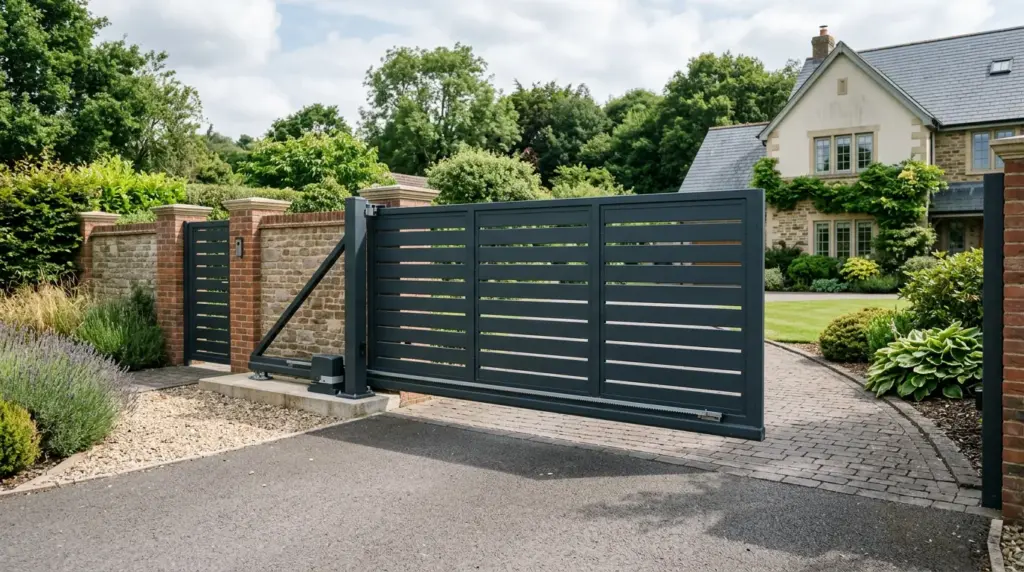
Trackless systems glide above the driveway with no ground friction, and they pair well with heavy-duty operators designed for frequent use. Pedestrian gates should be separate from vehicle gates wherever possible. A dedicated walking opening reduces wear on the main gate and gives visitors a clear, visible route that does not require stepping into the path of a car. This separation also improves safety and helps control access more effectively at the property boundary.
Automation should be planned before the concrete is poured, not added afterwards. Think about where the motor sits, how power reaches it, where the keypad or intercom is mounted and how a visitor is identified from inside the house. License plate recognition, video intercoms and smartphone alerts are now common, but they all depend on clean sightlines and sensible camera positions. A beautiful gate that cannot be operated easily in summer heat becomes a daily frustration.
Lighting, Planting and the Arrival Sequence
A boundary looks different after dark. Low-level wall lighting can wash a textured surface without creating glare for drivers or neighbours. A light at the front that switches on at dusk and off at dawn gives a consistent sense of occupation. Energy-efficient LED fittings are the practical choice for fixtures that run through the night. The aim is to reveal the edge of the property, not to flood the street with light.
Planting works with the boundary rather than against it. Trees should be pruned so that foliage and lower branches stay above head height, keeping sightlines open below the canopy. Shrubs near the front should mature no higher than about one metre. At the rear, climbing plants with thorns can protect fencing and drainpipes. The planting palette in the Gulf needs to tolerate heat, salt and limited water, so choose species that will not outgrow the boundary line within a few seasons.
The arrival sequence begins at the street edge. A visitor first sees the gate, then the driveway, then the front door. The boundary should frame that journey without shouting over the architecture. A calm, well-proportioned wall with a clearly marked pedestrian route and a restrained material palette often feels more secure than an aggressive barrier. Security comes from clarity, not from height alone.
- Keep front boundaries low and visually open so people and cameras can see along the street edge.
- Reserve taller solid walls for side and rear boundaries where privacy matters more than public sightlines.
- Choose trackless cantilever gates where sand and dust regularly collect on driveways.
- Separate pedestrian access from vehicle gates to reduce wear and improve daily safety.
- Plan gate automation, camera positions and intercom locations before civil work begins.
- Use low-glare LED lighting to reveal the boundary at night without creating dark pockets.
- Prune planting so mature growth supports surveillance rather than blocking it.
The boundary wall and gate should feel like part of the house, not a separate security product bolted onto the front. A well-designed boundary does more than mark property limits, as it also shapes privacy, arrival, and how the home is seen from the street. When the materials, heights and sightlines are resolved together, the result is a home that feels private without feeling closed. It reads as occupied, considered and calm.
Designing that edge well takes more than choosing a gate from a catalogue. It means walking the plot, understanding where people look from the street and from inside, and deciding what should be hidden and what should stay visible. In the Gulf climate, the boundary also has to survive heat, sand and salt air without constant maintenance. The best solution is always the one that fits the site, the household and the way the family actually moves through the day.